


My research interests center around neutrino oscillations, the mysterious phenomena where the 3 flavors of neutrinos, electron, muon, and tau change their flavor identity. This occurs because the mass states of the 3 neutrinos do not correspond to a single flavor, but rather to a weighted combination of the 3 flavors.
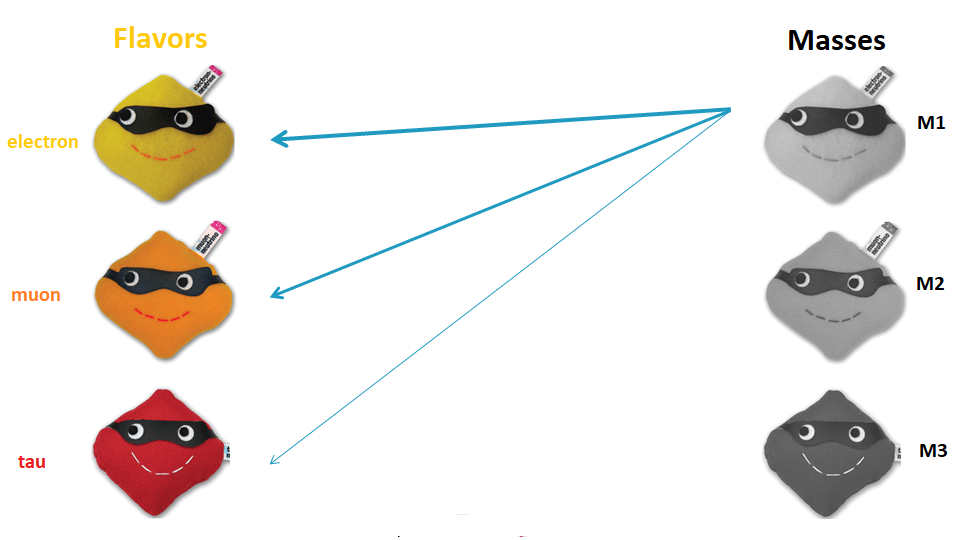
Diagram of how the neutrino of mass 1 is actually a mixture of mostly the electron flavor, with some muon and a little tau.
Neutrinos have been known to oscillate for some time and vacuum oscillations were used to solve the atmospheric neutrino problem. The discovery of the MSW effect, which allows neutrinos to transition to a different flavor state in matter, was used to explain the “missing” neutrinos emitted by the sun in the solar neutrino problem. Neutrinos are of such fascination to the science community that they were the subject of the 1988, 1995, 2002, and 2015 Nobel prizes in physics.
My area of interests lie in neutrino oscillations that occur outside the limited laboratory of earth, and even that of the sun. In a supernova explosion or compact object merger, neutrinos are produced in ludicrously large proportions. 99% of the gravitational binding energy of a supernova progenitor is carried away by the creation of neutrinos. These conditions allow for neutrino densities impossible to achieve on Earth, and allow for new types of oscillations to occur.
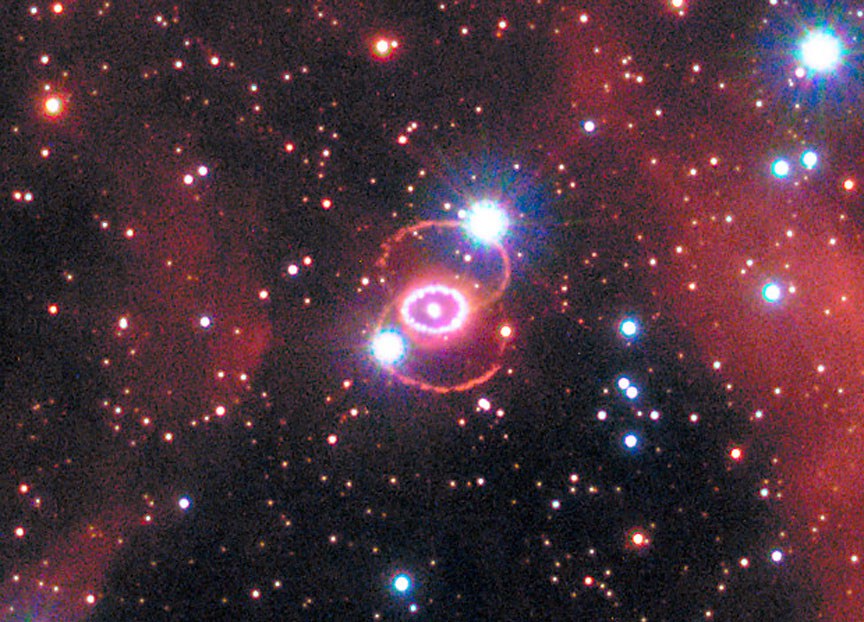
Supernova 1987a, the quintessential example in neutrino astronomy.
In the intense environment of the supernovae explosion, neutrinos can undergo effects caused by matter the matter (MSW effect), interactions with each other (Collective effects), a resonance caused by the matter and self-interaction potentials (MNR effect) and their normal vacuum behavior.
My research mainly deals with 2 aspects of astrophysical neutrino observations. First, I have been working on generating the signal that neutrino detectors on Earth would see from a supernova if neutrinos were allowed to interact with matter in a non-standard way (not described by the standard model). Neutrino astronomy is becoming a larger and larger part of the new idea of “multi-messanger astronomy” so understanding what the signals we receive tell us about the star is immensely important. Moreover, generating these signals with NSI included would allow us to place bounds the possibility of detected these types interactions.
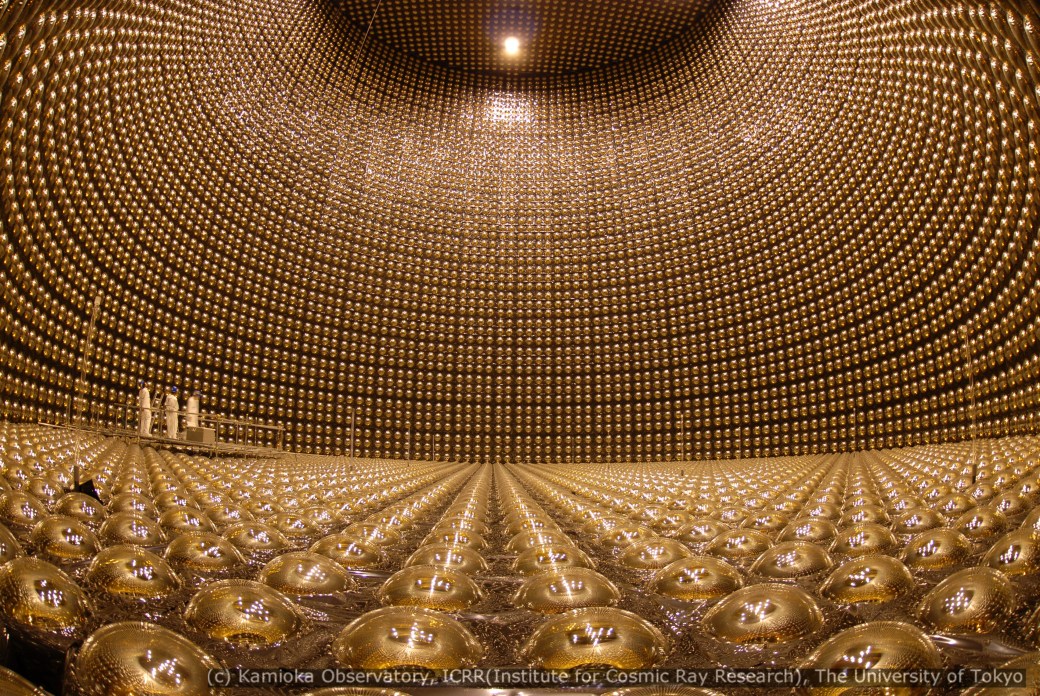
The Super Kamiokande neutrino detector in Japan. A prime candidate for neutrino astronomy.
My second interest involves investigating the possibility of “fast oscillations”, a sudden instability in the neutrino field that causes large flavor oscillations just above the neutrino-sphere where the particles are emitted. If fast oscillations occur, then neutrinos are undergoing unaccounted for transitions within 10km of being created and would greatly affect calculations concerning the elements produced in supernova explosions and the signal we would detect on Earth.
 Samuel DeLoy Flynn